Lesson 1
What is RAG (Retrieval-Augmented Generation)
Large Language Models (LLMs) like ChatGPT, Claude, and Gemini are incredibly powerful. They can write code, answer questions, summarize documents, and even help with complex reasoning tasks.
So naturally, many people assume they can answer any question.
But that's not true.
Try asking an LLM about something that happened recently, or a question about your company's internal documents. You may find that it either can't answer or, even worse, confidently gives you an incorrect one.
Why does this happen?
The answer lies in how LLMs work. While they're powerful, they also have some important limitations.
Understanding these limitations is the key to understanding Retrieval-Augmented Generation (RAG)—one of the most important techniques used to build reliable AI applications.
Before we learn what RAG is, let's first look at the limitations of a Large Language Model.
Limitation of a large language model
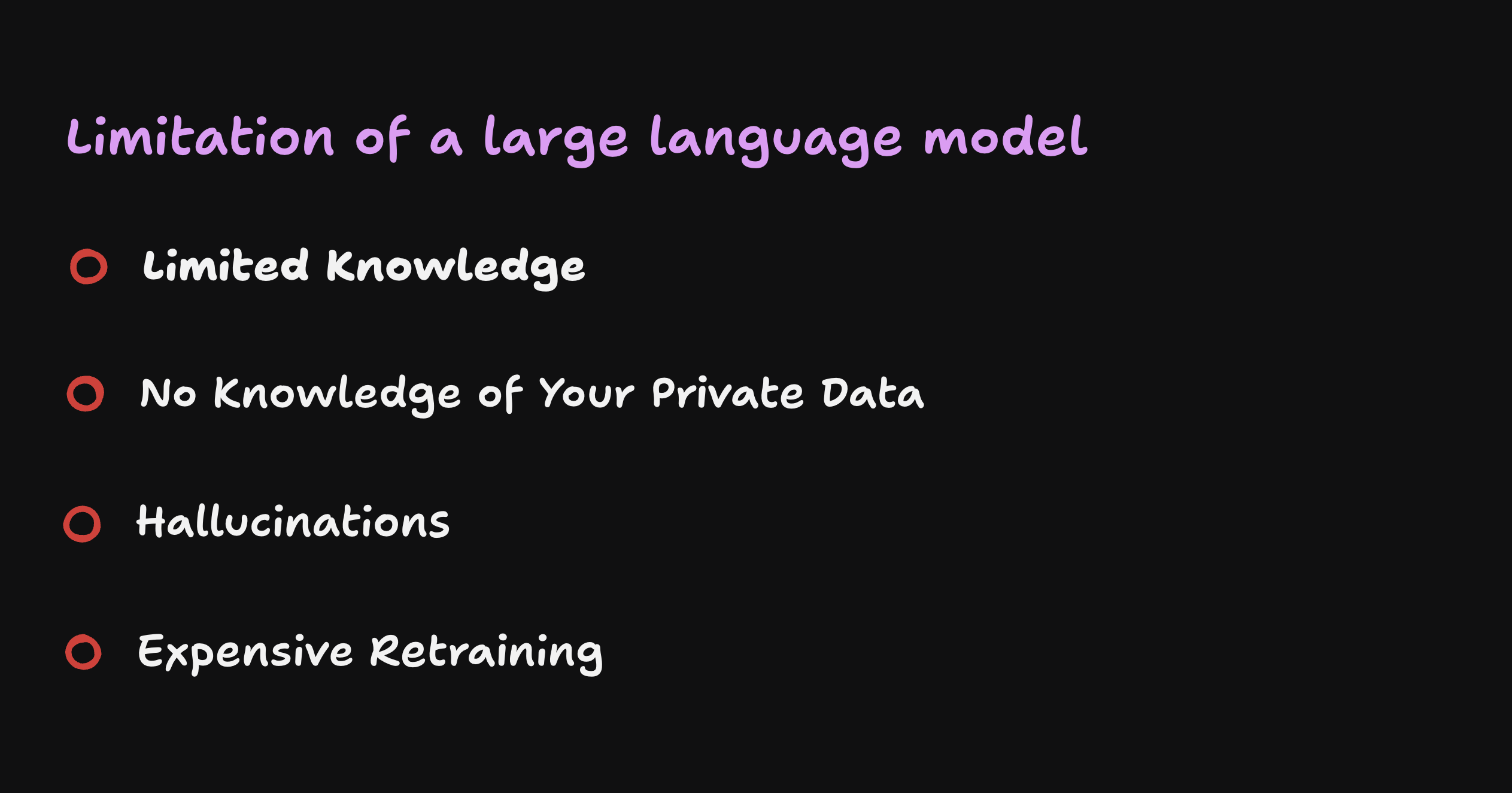
Limitation 1: Limited Knowledge
Imagine you ask Cluade - When is the next Brazil match?
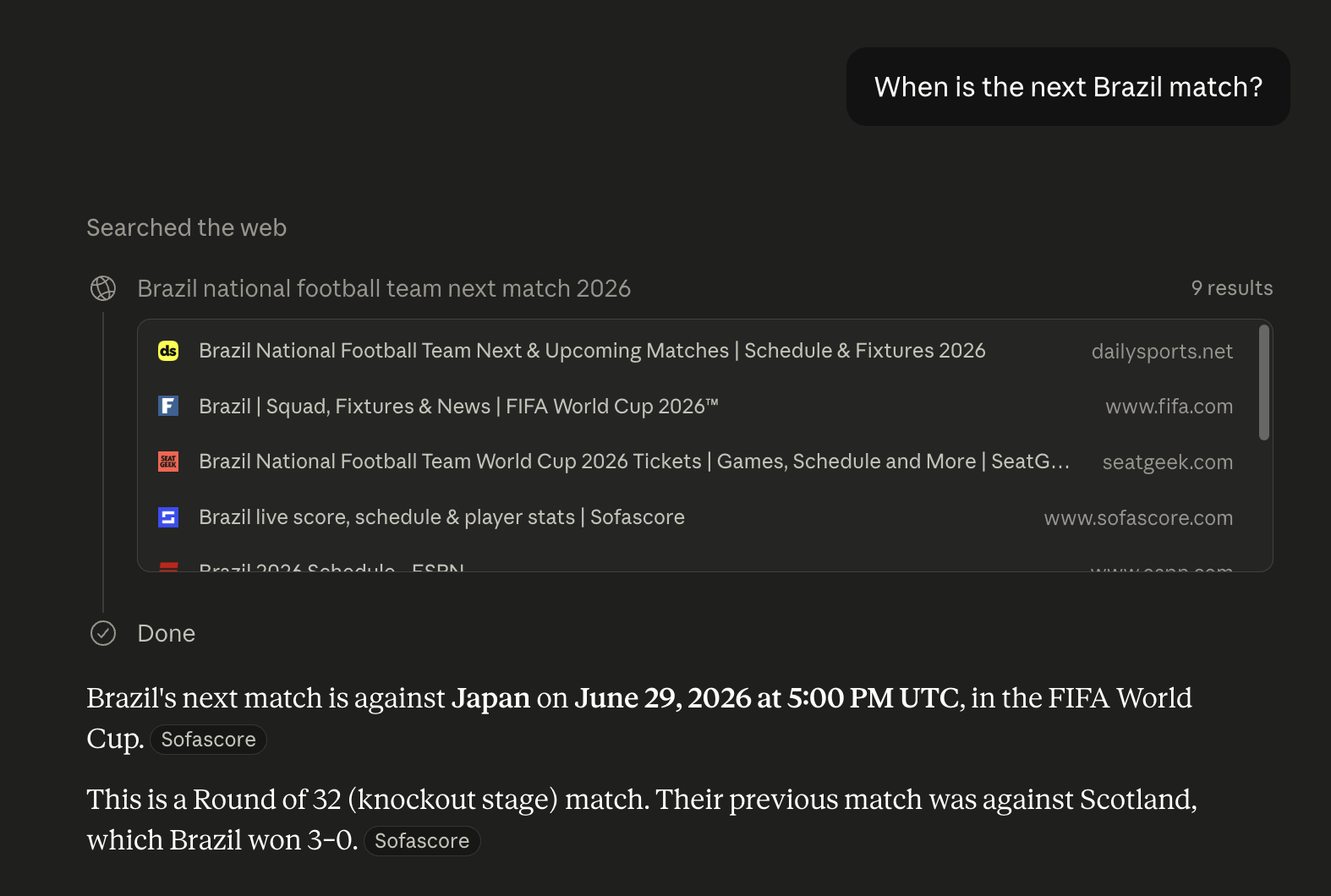
It cannot answer the above question without web search.
Every pretrained LLM has a knowledge cutoff date. An LLM only knows what it learned during training.
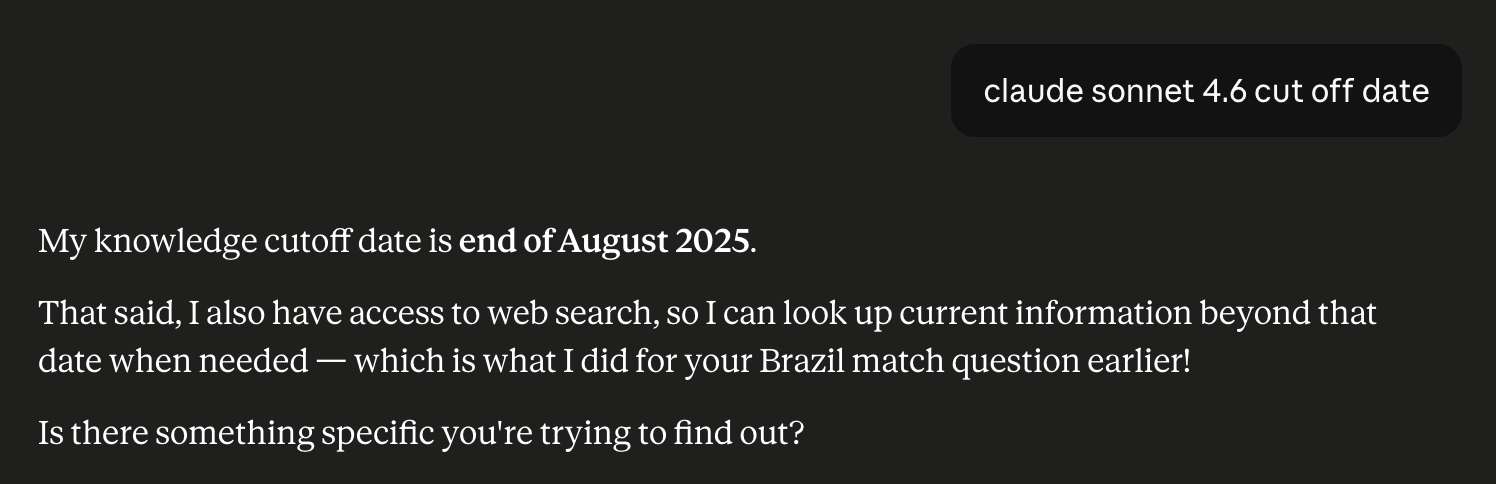
If something happened after its training cutoff, it has no idea unless it's connected to external information.
For example:
- Latest news
- Stock prices
- Today's weather
- New product releases
Without retrieval, the model cannot reliably answer these questions.
Limitation 2: No Knowledge of Your Private Data
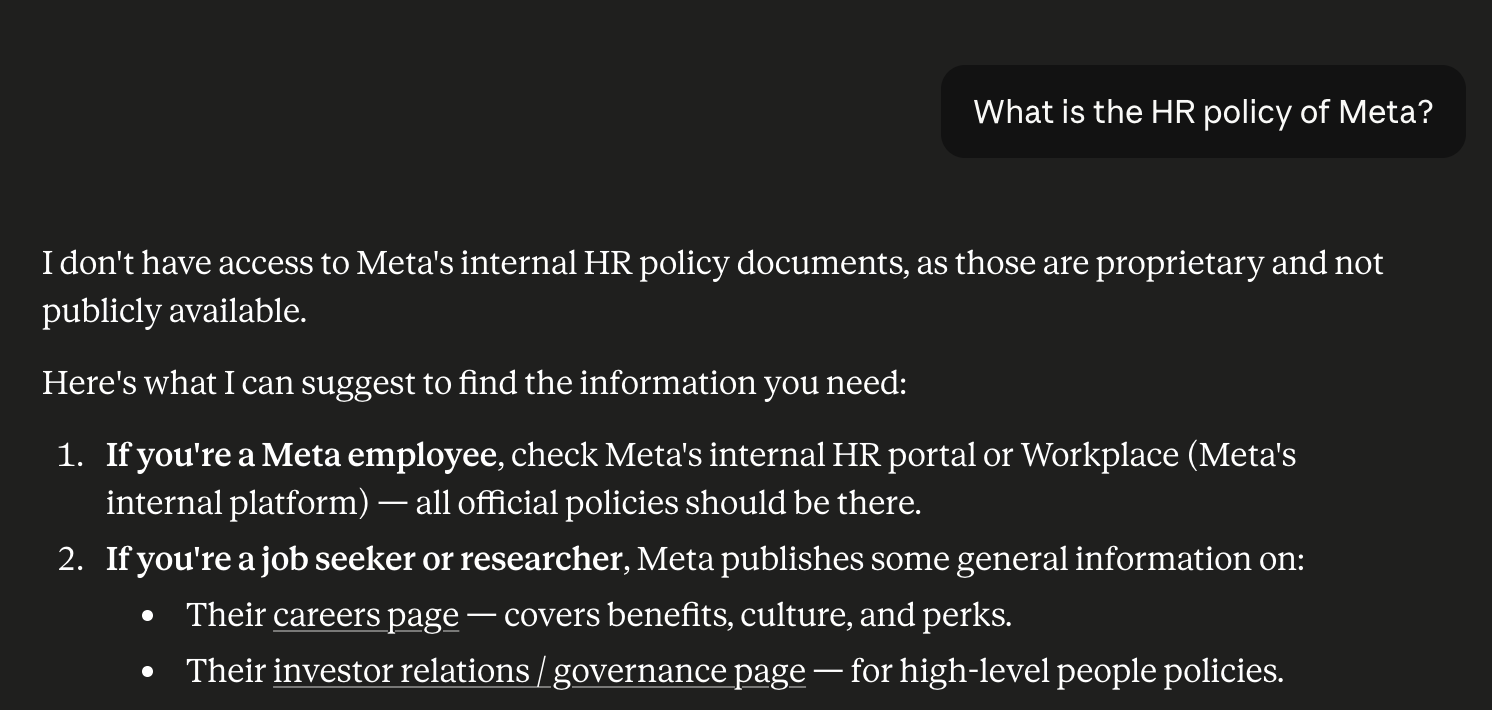
Let’s say you ask Claude - What is the HR policy of Meta? It can’t answer it - because the model has never seen Meta’s private documents.
Limitation 3: Hallucinations
Sometimes LLMs sound extremely confident...
...while being completely wrong.
This phenomenon is called a hallucination.
Because the model doesn't know the answer, it tries to generate something that looks correct.
With RAG, the model retrieves relevant documents and uses them as context for generating responses, which significantly reduces the likelihood of hallucinations.
Limitation 4: Expensive Retraining
But why can't we retrain our model with internal company's policies?
Suppose your company's policies change every week.
Should you retrain a billion-parameter model every week?
Of course not.
Training or fine-tuning large models is expensive and time-consuming.
Instead, simply update your documents.
RAG automatically retrieves the latest version whenever someone asks a question.
What is RAG?
RAG stands for Retrieval-Augmented Generation.
In simple words,
RAG is a technique that allows an AI model to retrieve relevant information from an external knowledge source before generating an answer.
Instead of relying only on what it learned during training, the model first searches for relevant documents, then uses those documents as additional context while generating its response.
Think of it like an open-book exam.
A normal LLM answers questions only from memory.
A RAG-powered LLM is allowed to quickly open a textbook, find the relevant pages, and then answer your question based on that information.
How does Retrieval-Augmented Generation work?
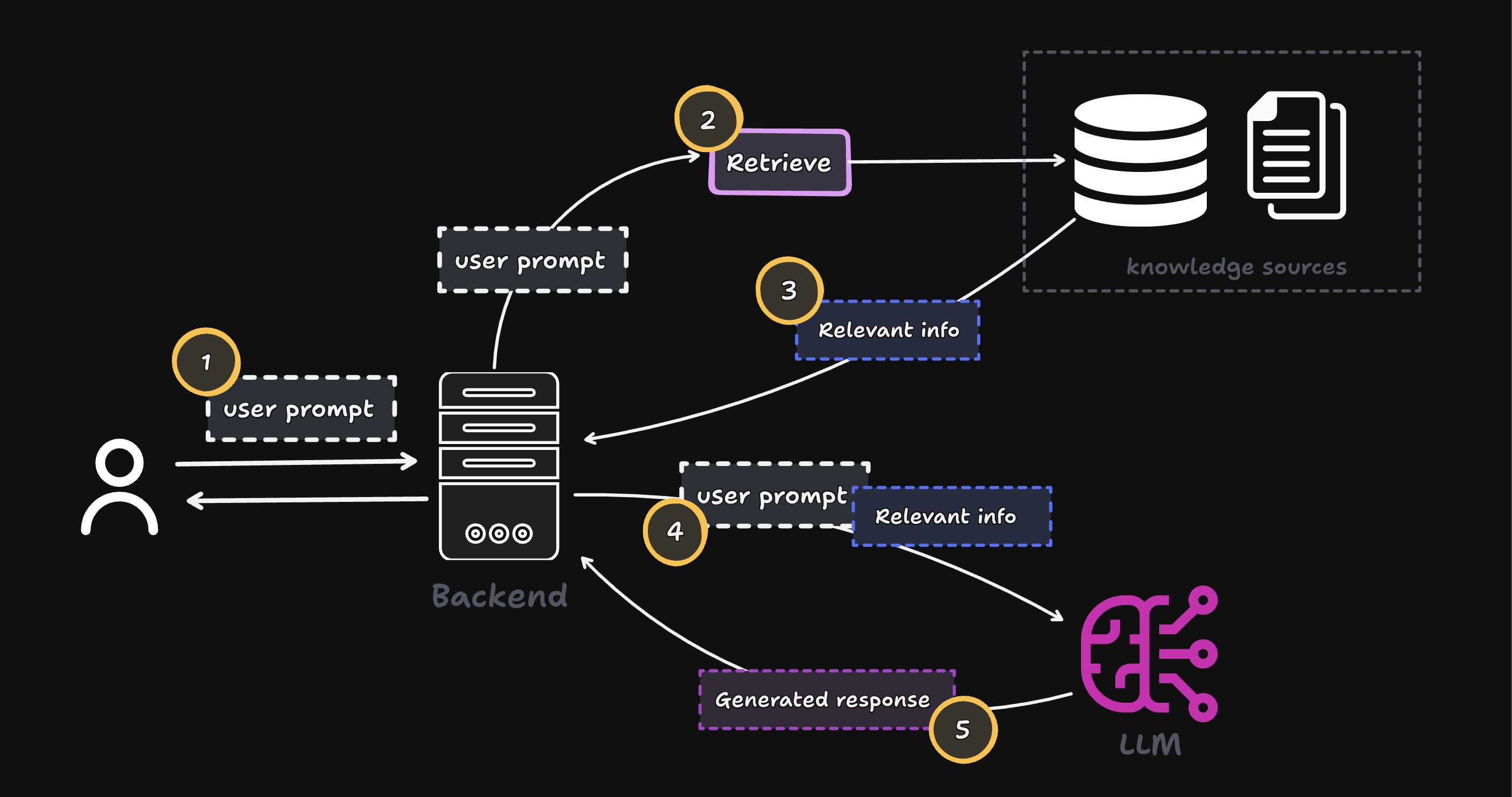
So the process becomes:
- User asks a question.
- Retrieve relevant information.
- Provide that information to the LLM.
- The LLM generates an accurate, context-aware answer.
That's why it's called Retrieval-Augmented Generation—we augment the generation process with retrieved knowledge.
Common Myth: Every RAG system uses a vector database.
This is one of the biggest misconceptions about RAG.
A vector database is not a mandatory component of every RAG system. Remember, the "R" in RAG stands for Retrieval, and there are many ways to retrieve information.
For example, you can retrieve documents using:
- Keyword search
- SQL queries
- APIs
- Traditional search engines like Elasticsearch
- Vector databases for semantic search
Vector databases are particularly useful when you need semantic search—finding information based on the meaning of a query rather than exact keyword matches.
However, if your data can be retrieved reliably using keyword search, a database query, or an API call, there's no need to introduce a vector database.
So remember, Not every RAG system needs a vector database. The retrieval mechanism should always be chosen based on the type of data and the problem you're trying to solve.
But, If your RAG application uses semantic search, a vector database becomes an important part of the retrieval pipeline. If you'd like to understand embeddings, similarity search and how vector database works - check out my Vector Databases Masterclass:
Vector Databases Masterclass: From Zero to Advanced
Advantages of RAG
Let's summarize why RAG has become one of the most important techniques in Generative AI.
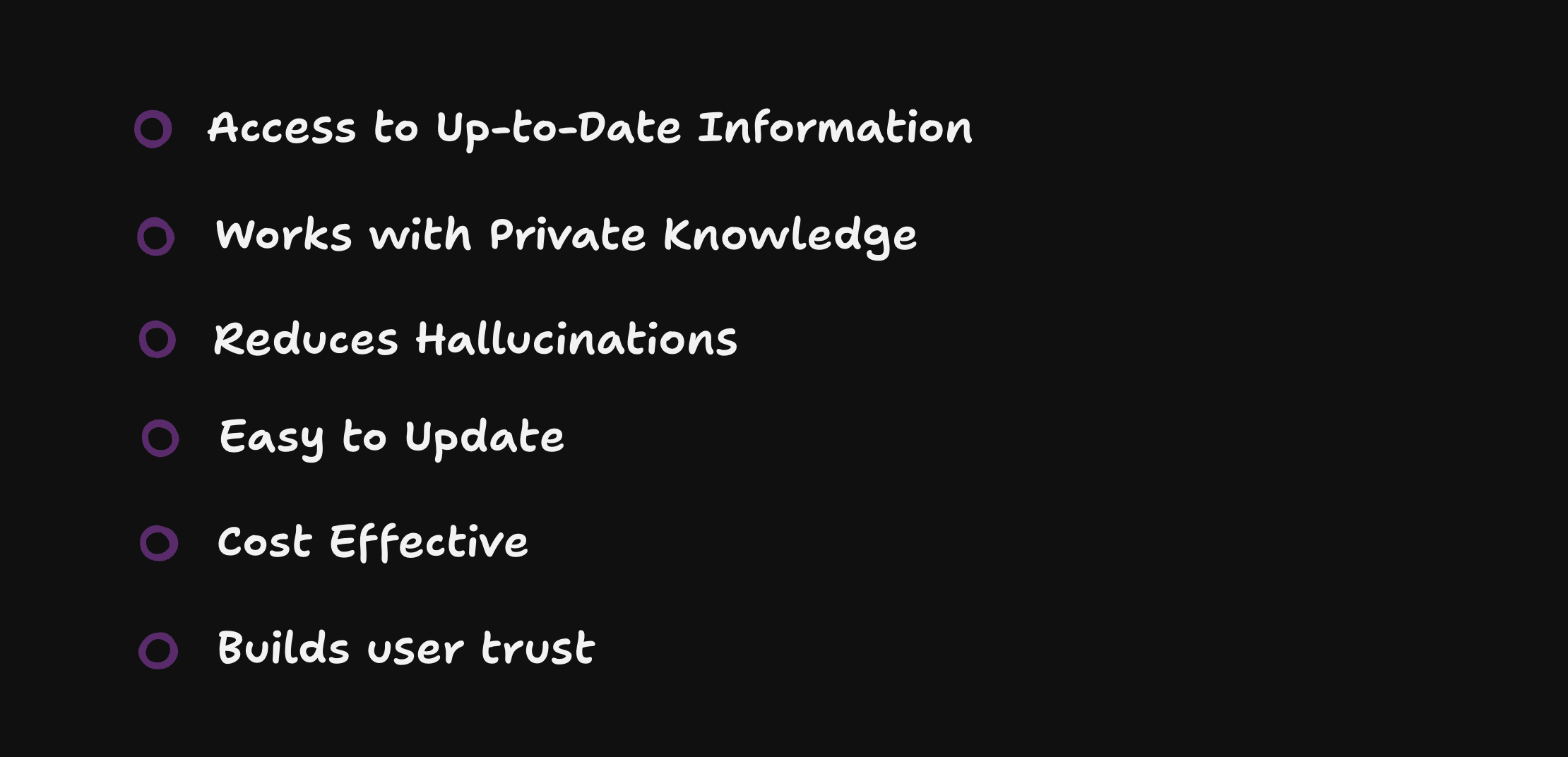
1. Access to Up-to-Date Information
RAG can retrieve the latest information from external sources.
This means your AI can answer questions about today's events, recent product launches, or newly published documents.
2. Works with Private Knowledge
RAG allows your AI to answer questions using:
- Company documents
- PDFs
- Confluence
- SharePoint
- Databases
- Knowledge bases
Without retraining the model.
3. Reduces Hallucinations
Since the model answers based on retrieved documents instead of pure memory, responses become much more accurate and trustworthy.
4. Easy to Update
Need to update your knowledge?
Simply add or modify the documents.
There's no need to retrain the LLM.
5. Cost Effective
Training or fine-tuning large language models can cost thousands or even millions of dollars.
RAG avoids this cost by keeping the model fixed and updating only the external knowledge base.
6. Builds user trust
One of the biggest advantages of RAG is transparency.
You can even show users the documents or passages that were used to generate the answer.
This builds trust because users can verify the information themselves.
Key Takeaways
Let's quickly recap what you've learned:
- Large Language Models are incredibly powerful, but they're not perfect. They have a knowledge cutoff, can't access your private data, can sometimes hallucinate, and are expensive to retrain.
- RAG (Retrieval-Augmented Generation) addresses these limitations by retrieving relevant information from external sources before the LLM generates a response.
- At a high level, the RAG workflow is simple: Retrieve relevant documents → Provide them to the LLM as context → Generate the answer.
- Because the model grounds its answers in retrieved documents rather than relying only on its memory, the responses are typically more accurate, relevant, and trustworthy.
- One of RAG's biggest strengths is that it can work with both up-to-date information and private organizational data without changing the underlying model.
- Keeping a RAG system current is easy—you simply update the knowledge base instead of retraining the LLM, making it both faster and more cost-effective.
- Finally, because RAG can reference the documents used to generate an answer, it adds transparency and helps users trust the information they're receiving.